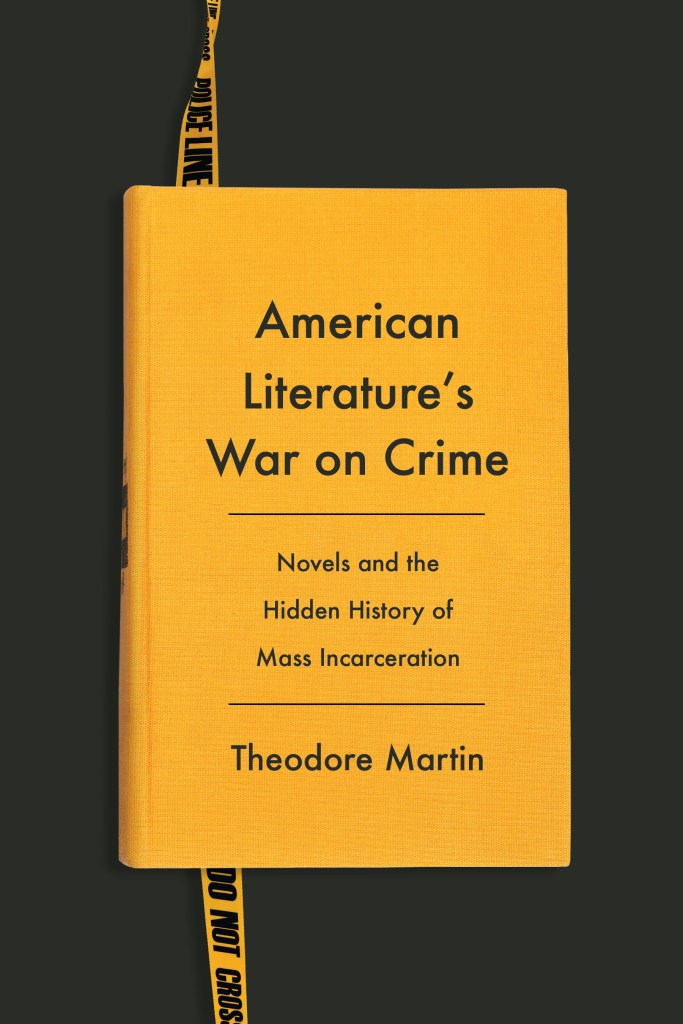
American Literature’s War on Crime: Novels and the Hidden History of Mass Incarceration
Columbia University Press, 2026 (part of the Literature Now series)
While the United States was building the world’s largest prison system, Americans were reading crime novels. What did it mean to read crime fiction in a “tough-on-crime” era? How were fictional stories about crime linked to cultural narratives about criminality, class, and race? What did novels have to do with the making of mass imprisonment in America? Theodore Martin offers a groundbreaking account of the ways that reading habits and crime politics intersected in the age of mass incarceration. He shows how the War on Crime was waged on the page, arguing that fiction made the policies and ideologies of crime control legible to diverse readerships. Rewriting the history of one of the past century’s most popular genres, this ambitious book reveals how the rise of mass incarceration transformed American crime fiction—and how crime fiction became a key battleground in the War on Crime.
“With breathtaking scope, American Literature’s War on Crime argues convincingly that detective novels, vigilante narratives, and serial killer stories were instrumental to changes in policing and public policy. A remarkable book.
—Justin Gifford, author of Revolution or Death: The Story of Eldridge Cleaver
“With rigorous analysis and lively prose, American Literature’s War on Crime shows in luminous detail the ways that crime fiction was shaped by and in turn shaped decades of disastrous crime policy. This first of its kind volume promises to draw audiences capacious as the scope of its own argument. An astonishing achievement.”
—Travis Linnemann, author of The Horror of Police
“Martin’s impressive book flouts distinctions between prestige and pulp to show how literature helps us make sense of why we repeatedly choose mass incarceration as the solution to the ‘War on Crime’.”
—Michelle Robinson, author of Dreams for Dead Bodies: Blackness, Labor and the Corpus of Detective Fiction
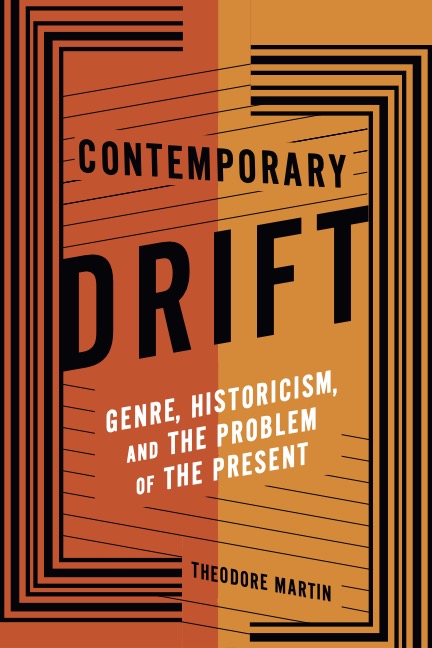
Contemporary Drift: Genre, Historicism, and the Problem of the Present
Columbia University Press, 2017 (part of the Literature Now series)
What does it mean to call something “contemporary”? More than simply denoting what’s new, it speaks to how we come to know the present we’re living in and how we develop a shared story about it. In Contemporary Drift, Theodore Martin argues that the contemporary is not just a historical period but also a conceptual problem, and he claims that contemporary genre fiction offers a much-needed resource for resolving that problem. Studying a wide range of novelists and filmmakers, Martin shows how genre fiction, with its mix of old and new, brings to light the complicated process by which we make sense of our present and determine what belongs to our time.
“Through a series of brilliant readings of revived and emergent genres—westerns, noir, postapocalyptic fiction—which invent ways of thinking about temporalities directly shaped by the dynamics of advanced capitalism, Martin works against the one-sidedness of recent debates to show how form and history inform one another in contemporary fiction. Revealing how aesthetic objects can become a resource for reimagining historicism in a present rendered simultaneously more encompassing and more elusive than ever, Contemporary Drift is a must-read for those who study the culture of the present and the aesthetics of capitalism.”
—Sianne Ngai, University of Chicago
“Contemporary Drift is a terrifically successful ‘experiment in too-close reading,’ not just because it offers smart, ethically grounded, and beautifully written interpretations of recent fiction and films. It is also a successful experiment because it is ongoing: it acknowledges all that we cannot yet know about our present moment, but demands that we keep trying anyway.”
—American Literary History
“The contemporary is a category on the minds of many literary scholars, and Theodore Martin’s impressive new book tells us why. . . . Those sympathetic to such endeavors and invested in the epistemological powers of literary and cinematic form will delight in Contemporary Drift. Those who would grant historicism a less ringing endorsement will find Martin’s metacritical work on the making of historical concepts invaluable as well.”
—Novel: A Forum on Fiction
“Martin combines fierce political and historical acumen with impressively detailed formal analysis, making Contemporary Drift one of the most stimulating and original books on genre to appear in recent years”
—The Year’s Work in English Studies
 Theodore Martin
You must be logged in to post a comment.